



AI adoption is accelerating, but measurable business value remains elusive. Adoption alone does not create business value. Value appears when AI changes a workflow, a decision, a product or a business model, and improves an outcome the organisation can measure.
When does AI start creating business value?
A successful AI output is not yet a business result. Even time saved only becomes value when the organisation converts it into a better outcome, such as:
- shorter cycle times or faster onboarding
- fewer errors, incidents or compliance risks
- better conversion or customer service
- more capacity for higher-value work
Every use case therefore needs an explicit value hypothesis. What should change, how will it be measured, and who owns the result after go-live?
What are the three routes from AI to impact?
Organisations can create value with AI in three distinct ways:
- Improve: make existing work faster, better or less risky.
Measure cost, quality, cycle time, compliance or decision speed. - Wrap: strengthen an existing product or service with AI.
Measure retention, conversion, pricing, service quality or differentiation. - Create: build a new proposition, service or business model.
Measure new revenue, adoption or access to new markets.
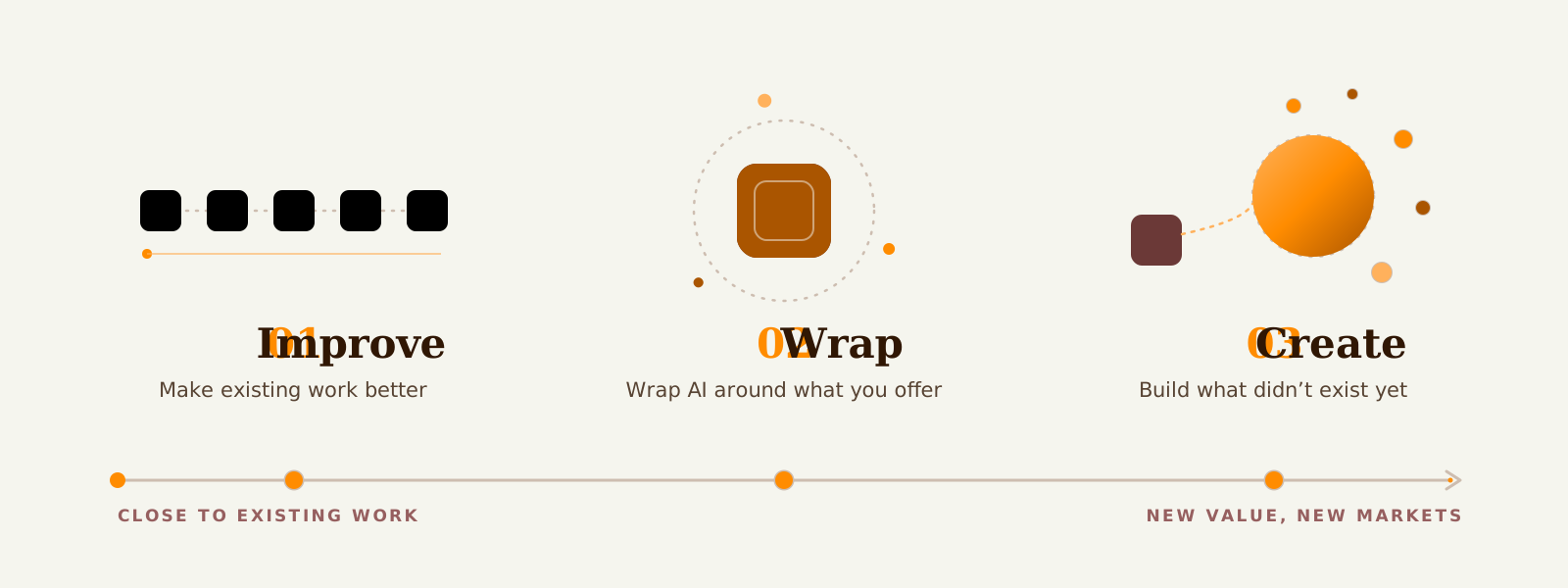
Improve is often the easiest place to start. But automating a weak process simply makes the weakness move faster, so the surrounding workflow has to change too.
Why does workflow redesign matter more than the AI tool?
AI tools usually create local productivity gains. Workflow redesign changes the economics of an entire function. A service employee who drafts one reply faster is useful. A service flow in which AI triages requests, retrieves context, suggests responses, flags risk and escalates only the exceptions can improve speed, cost and quality at the same time.
Redesign the work; do not reduce value to headcount. Cutting roles does not automatically improve a process. A stronger objective is to automate repeatable work so that people can focus on judgement, relationships and complex exceptions.
What operating model helps AI scale?
Promising pilots stall when ownership, governance, data and adoption remain unclear. A practical AI operating model defines:
- Strategy: which business priorities should AI support?
- Ownership: who owns the use case, the process change and the measurable value?
- Governance: who tests, approves, scales or stops an initiative?
- Foundations: which data, platforms and reusable components are required?
A small centre of expertise can provide shared guardrails and tools, while business-led teams keep ownership of the result. That link between priorities, ownership and value is what an AI value creation plan makes explicit.
From AI activity to repeatable impact
 The hard part now is discipline: choosing use cases, testing them against agreed outcomes, scaling what works and stopping what does not. Each use case that makes it through that process also makes the next one cheaper to deliver.
Chapter 1 of the Digital Excellence Report 2027 covers the operating models and capabilities behind AI that pays off.

AE
Related insights

Discover the key announcements from FabCon Europe 2026. Our experts, who attended the event, share insights, takeaways and what it means for your organisation.

Most platforms weren't built for what's coming next. Roshni Bhogaita of Storyblok explains what AI-ready content infrastructure actually looks like.

When agents handle the backlog, what do engineers focus on? Jeremy Eder on the human side of the shift to agentic software development.