


AI is turning legacy modernisation from one large, opaque gamble into a sequence of smaller steps that organisations can plan and test one at a time. Legacy remains complex, but the path to modernising it is becoming safer and easier to fund.
Why are legacy systems now a strategic constraint?
Core applications contain years of accumulated business logic and complex integrations. They are essential to daily operations, yet difficult to change and often understood by only a handful of experts. What was once seen primarily as technical debt has become a strategic business challenge, limiting access to data, AI adoption and the pace of innovation.
How does AI reduce the risk of legacy modernisation?
AI agents can take on meaningful work across the modernisation lifecycle:
- analyse source code and reconstruct an architectural view
- extract undocumented business rules and dependencies
- create documentation that experts can review and challenge
- generate tests that capture how the current system behaves
- translate validated requirements into modern code
This makes it possible to organise the programme around bounded business use cases instead of replacing an entire application at once. Every step produces evidence, reduces uncertainty and informs the next investment decision.
Why must intent come before code generation?
Pointing an agent at a large codebase and asking it to modernise everything may produce fast output, but the result is hard to audit and harder to defend.
A safer approach separates understanding from generation:
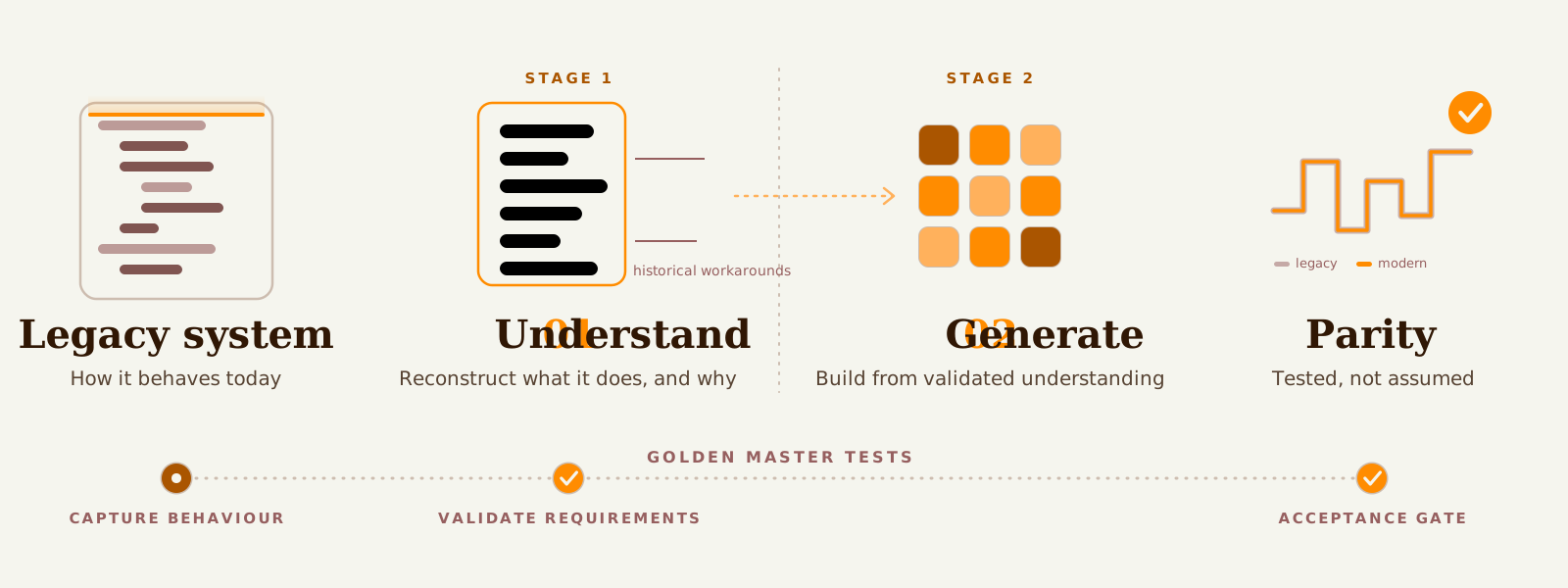
- Stage 1: reconstruct and validate what the legacy system does, and why.
- Stage 2: generate the modern solution from that validated understanding.
Discovery also separates genuine business requirements from historical workarounds, so the organisation avoids rebuilding complexity that no longer serves a purpose.
Golden-master tests provide the proof. They capture how the legacy application behaves today. First they validate the reconstructed requirements; later they become the acceptance gate for the modern build. Functional parity is tested, not assumed.
What is an AI-enabled modernisation factory?
After the first successful use cases, modernisation should not restart from zero. A governed factory reuses the assets and lessons developed along the way:
- agents and prompts adapted to the organisation's environment
- specifications and reusable test harnesses
- architecture, security and coding standards
- dashboards, validation gates and escalation rules
Engineers remain responsible for intent, architecture, quality and exceptions. Agents take on a growing share of analysis, documentation, translation and testing. This is the model behind AI-enabled legacy modernisation.
How does reuse change the economics?
 The first use case can start smaller because AI compresses discovery and preparation. Later use cases move faster because the organisation reuses both its technical assets and its accumulated knowledge.
The risk does not disappear, but it becomes manageable: instead of one high-stakes rewrite, you get a series of smaller upgrades, each tested before the next one starts. That makes legacy one of the clearest places to demonstrate measurable AI value.
The full execution model, including how to set up a modernisation factory, is in chapter 3 of the Digital Excellence Report 2027.
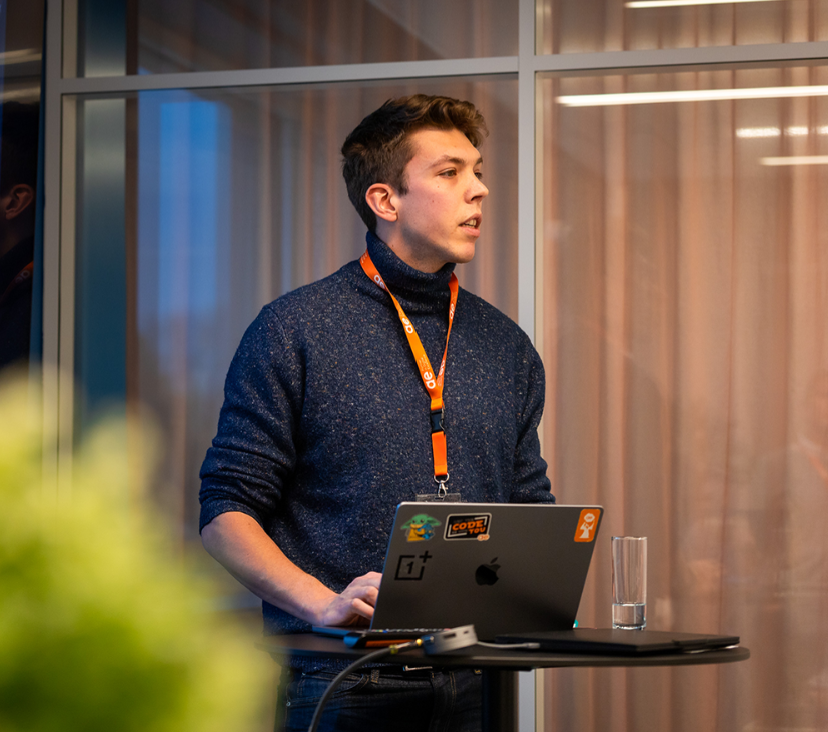
Koen Goovaerts
Koen is a software engineer and technical architect with over 10 years of experience leading complex software projects. He has worked extensively with both modern architectures and challenging legacy systems, excelling at making legacy software more maintainable and guiding teams in evolving critical systems. Passionate about coaching and knowledge sharing, Koen helps teams grow their technical maturity in areas such as software design, testing, agile practices, architecture and legacy code. He is a trusted sparring partner for leaders looking to strengthen their teams, modernise legacy systems and deliver sustainable software improvements.
Related insights

Discover how Microsoft Fabric supports user-friendly, scalable data governance to help your organisation build trusted, reusable data products.
Discover what the migration from Power BI Premium to Microsoft Fabric means for your organisation, including key dates, steps, and licensing changes.

AI adoption often falls short of expectations. Discover how value stream mapping reveals structural constraints and enables scalable, real impact with AI and...